Firm-level Climate Change Adaptation
Initiative in Sustainable Finance: Research Highlight by Tobias Schimanski, PhD Candidate

The paper studies how firms adapt to physical climate risks (storms, floods, heatwaves, droughts, wildfires, coldwaves) and whether such adaptation mitigates financial losses from extreme weather events.
It responds to the gap that most existing work measures firms’ physical climate exposure, but not how they actually adjust operations, finances, and governance to cope with these risks over time. Using U.S. public firms’ 10-Ks, the author constructs a systematic, firm-level adaptation metric spanning over two decades and links it to both climate damages and financial outcomes.

„I develop a method that identifies climate change adaptation actions and solutions of firms. Using a Large Language Model-based classification system, I measure firm's climate adaptation actions in the subcategories physical protection, adaptive operations, risk transfer, financial reserves, and risk assessment.“
-Tobias Schimanski, PhD Candidate at the UZH Department of Finance and the Department of Humanities, Social and Political Sciences, ETH Zurich
Methodology
The author builds a hierarchical adaptation framework based on definitions from IPCC, ISO, UNFCCC and UNEP FI, distinguishing between (i) adaptation actions (firms preparing themselves) and (ii) adaptation solutions (firms helping others adapt). Adaptation actions are further split into five categories: physical protection, adaptive operations, risk transfer, financial reserves, and risk assessment.
To operationalize this framework, the paper fine-tunes a set of open-weight Large Language Models (based on Qwen2.5-7B-Instruct) in a teacher–student setup: GPT‑4.1 acts as the teacher on a manually labeled benchmark of 1,000 paragraphs, then the student models are trained on 6,000 LLM-labeled paragraphs. A multi-step text pipeline pre-filters climate-related paragraphs using existing physical risk and extreme weather classifiers, then applies the adaptation, action-vs-solution, and category classifiers to 255 million paragraphs from 128,860 10-K filings of 13,500+ firms for 2003–2025.
Firm-year adaptation measures are defined as the number of adaptation-related paragraphs (by category) divided by the total number of paragraphs in a filing, scaled per 1,000 paragraphs. The paper validates the measures via:
- (i) benchmark classification metrics (precision/recall/F1),
- (ii) comparison to keyword-based approaches,
- (iii) correlations with external physical risk and climate solution measures,
- (iv) time-series co-movement with NOAA damage data, and
- (v) industry-level patterns.
Economic applications use difference-in-differences designs around hurricane landfalls combined with establishment-level exposure and stock return data, as well as regressions relating adaptation to financial constraints.
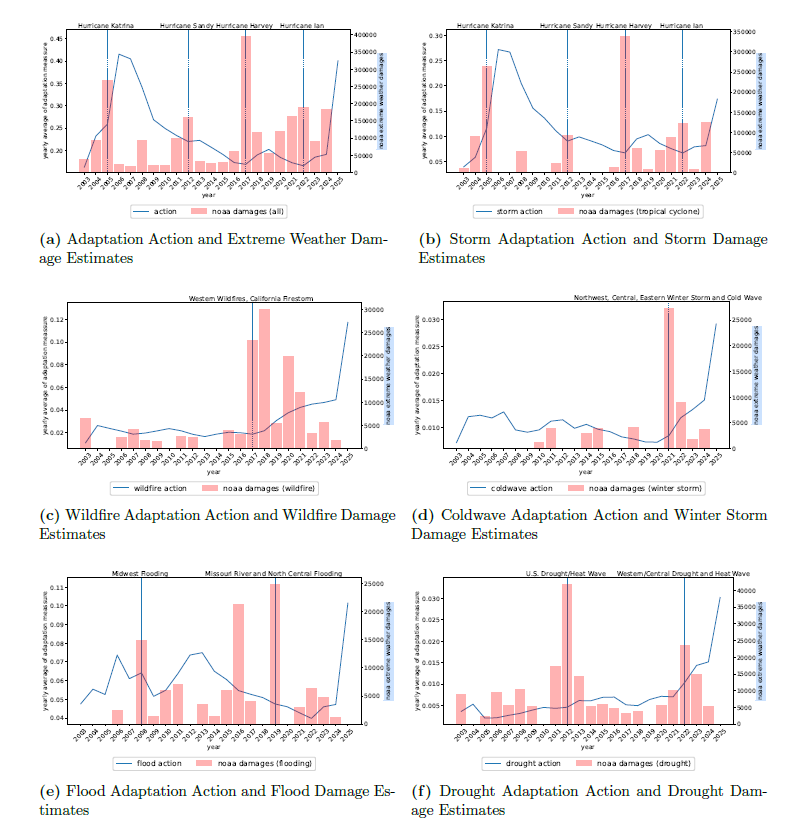
Figure 1: Time-series figure of average adaptation actions vs. NOAA extreme weather damages (Figure 1a): it visually shows that adaptation action disclosures rise after major damage years (e.g. Katrina, Sandy, Harvey, Ian), and that adaptation spikes again toward the end of the sample.
Key Findings
- First, adaptation disclosure is non-trivial but selective: 28.4% of firms mention adaptation at least once, and 19.6% of firms mention adaptation in a given year; on average, filings contain 0.287 adaptation paragraphs per 1,000 paragraphs, dominated by actions rather than solutions. Within actions, risk transfer (e.g., insurance) is most frequently discussed (0.192 per 1,000 paragraphs), while physical protection and financial reserves appear least frequently.
- Second, the measures validate well: the adaptation classifier achieves precision of 0.87 (overall accuracy 0.83), and action/solution labels reach F1-scores of 0.97 and 0.90, respectively, with subcategories showing recall between 0.83 and 1.00. Compared to keyword-based baselines (including narrow “adaptation/resilience” dictionaries and BoW unigrams/bigrams), LLM-based classifiers consistently deliver higher recall and F1, especially for nuanced categories like solutions and risk assessment.
- Third, adaptation is strongly associated with physical climate risk exposure: a one standard deviation increase in earnings-call-based physical climate exposure (Sautner et al., 2023) is linked to roughly a 16% increase in adaptation actions relative to the mean. Acute climate risk (extreme events) shows particularly strong correlations (one standard deviation corresponds to a 54% increase in actions), while chronic risks still matter (about 26% increase), and adaptation solutions also correlate positively with climate solutions measures.
- Fourth, adaptation responds to realized climate damages: time-series plots show that average adaptation actions increase following years with high NOAA-recorded extreme weather damages, with notable upticks after events like Hurricane Katrina, Sandy, Harvey, and Ian. Disaggregated by hazard type, storm, flood, wildfire, coldwave, and drought adaptation measures all display visible increases after severe damage years in their respective NOAA categories.
- Fifth, adaptation is highly heterogeneous and largely firm-specific: variance decomposition shows that time effects explain less than 1% of variation, industry fixed effects only around 5–18% (depending on the measure), while 79–93% of the variation resides at the firm level. Within this firm-level component, around 42–58% is persistent (firm fixed effects), while the rest reflects time-varying, within-firm adjustments, especially for operational and physical protection measures
- Sixth, pre-event adaptation mitigates stock market losses from hurricanes: exposed firms experience significantly negative cumulative abnormal returns after landfall, but higher pre-event physical protection systematically dampens these losses. A one standard deviation increase in physical protection is associated with about a 0.5 percentage point higher cumulative abnormal return over a 20-day window, offsetting roughly 26% of the negative stock price reaction on average, and up to 37% for small firms and asset-intensive industries.
- Seventh, financial constraints significantly reduce adaptation: a one standard deviation increase in the Whited–Wu or SA index is linked to a 4–14% reduction in adaptation actions (and up to roughly 9–23% reductions in physical protection, adaptive operations, and financial reserves) relative to sample means. In stacked DiD around hurricanes, exposed firms increase adaptation actions by about 10–11% relative to the mean, but this post-event response is much weaker for financially constrained firms, effectively offsetting around one-third of the adaptation increase observed among unconstrained peers.
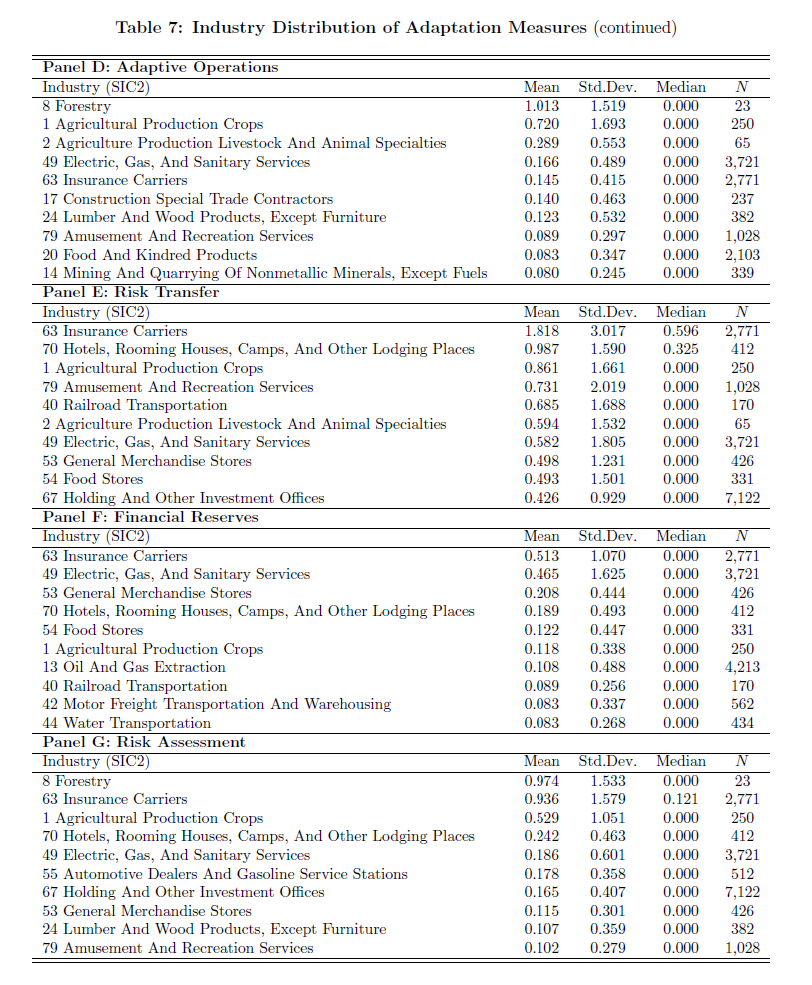
Table 7: Industry ranking table (Table 7 – Panel A and E): it shows how adaptation actions and risk transfer are concentrated in sectors like Insurance Carriers, agriculture, forestry, utilities, and hotels, emphasizing sectoral differences in adaptation strategies.
Implications and Conclusions
The findings suggest that firm-level adaptation is both measurable and economically meaningful: investors appear to price pre-event adaptation, particularly tangible physical protection, as a credible signal of resilience to physical climate shocks.
However, because most variation is firm-specific and financial frictions dampen both baseline adaptation and post-shock responses, financially constrained firms may contribute disproportionately to systemic physical climate risk.
For regulators and policymakers, the results highlight that disclosure-based adaptation metrics can complement exposure measures to gauge firms’ preparedness and to identify vulnerable segments of the economy.
For investors and risk managers, the paper underscores the importance of differentiating between adaptation channels (physical, operational, financial, and informational) and of paying attention to firm heterogeneity (size, sector, financial health) when assessing climate resilience.
More Information:
- Schimanski, Tobias, Firm-level Climate Change Adaptation (April 05, 2026).
Available at SSRN: https://ssrn.com/abstract=6710044 - Data and Models: https://huggingface.co/climate-adaptation
- Image source: Salman Ahmad via Unsplash